Puritanism
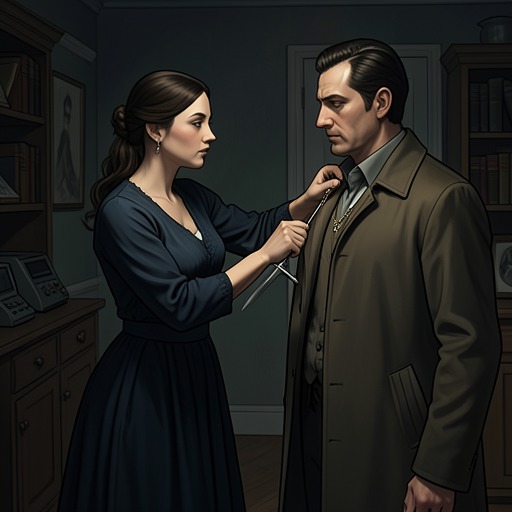
The Three MusketeersPuritanism is a severe Protestant religious identity and ideological language that shapes the imprisonment scenes involving Milady and Felton. In the novel, it is associated with plainness, hostility to Catholic ceremony, hatred of perceived corruption, and an intense expectation of divine judgment. Its decisive narrative importance lies in the way Milady recognizes this moral vocabulary and turns it against Felton, making her own revenge appear to him as religious duty and national deliverance.
Religious Identity and Visible Signs
Puritanism first appears through signs of discipline and rejection. When Felton offers Milady a manual containing the ordinary of the Mass, she studies him rather than accepting the book. His simple arrangement of hair and extremely plain costume allow her to recognize him as one of the gloomy Puritans she has encountered at the courts of King James and the King of France. The scene establishes Puritanism not merely as a doctrine but as a visible social identity, legible through dress, grooming, manner, and attitude toward Catholic ritual.
The Catholic book becomes a test of allegiance. Milady refuses to touch it and calls the offer a snare laid by Lord de Winter, whom she describes as a corrupted Catholic. She claims that her faith has been persecuted and declares that God must either save her or allow her to perish for God. Her language imitates the posture of a religious martyr, while her accusation that Felton is an accomplice in Lord de Winter’s persecutions and heresies turns religious difference into a personal indictment. Puritanism therefore enters the scene as a vocabulary of resistance against established authority, Catholic institutions, and imposed ceremonial conformity.
Puritan Judgment and Political Hatred
Felton’s Puritanism is inseparable from his hatred of George Villiers, Duke of Buckingham. When Milady refers contemptuously to the duke as “that wretch,” Felton immediately understands whom she means. He declares that the hand of the Lord is stretched over Buckingham and that the duke will not escape the chastisement he deserves. The statement shows a providential model of politics: public power is interpreted through divine punishment, and opposition to a statesman can be experienced as obedience to God.
The novel contrasts the different labels attached to Buckingham. Catholics call him an extortioner, pillager, and debauchee, while Puritans call him Satan. Milady exploits this already existing public hatred, presenting her own desire for vengeance as a prayer for the deliverance of an entire nation. Her appeal is effective because it joins Felton’s religious convictions to his political resentment. Private accusation is enlarged into national crisis; personal revenge is disguised as collective salvation.
Milady’s Appropriation of Puritan Language
Milady’s method is not to argue calmly but to perform the emotional and verbal signs of Puritan zeal. She presents herself as a persecuted believer whose faith has been tested by violence, humiliation, and the threat of permanent bodily defilement. Addressing Felton as though he were her brother, she invites him to imagine her suffering within the intimate moral structure of family and shared belief. Her narrative of resistance makes persecution the central proof of spiritual authenticity: the more violently she is treated, the more convincing her claim to sanctity appears.
Her rhetoric reaches its theatrical climax when she invokes the image of a victim sent to Baal and a martyr thrown to lions. Felton sees her as neither an ordinary prisoner nor simply a beautiful woman, but as a supernatural religious figure, asking whether she is a messenger from God, a minister from hell, an angel, or a demon. Milady answers that she is a daughter of earth and a sister of his faith. The claim is carefully balanced: she rejects supernatural identity while asserting spiritual kinship. By calling herself Felton’s sister in faith, she enters the symbolic family that his Puritanism has made sacred and makes his failure to rescue her appear like betrayal.
She then attacks Felton’s loyalty as logically inconsistent. If he believes, she asks, how can he remain an accomplice of Lord de Winter, whom she portrays as an enemy of England and of God? How can he leave her among her enemies or deliver her to Buckingham, whom she names an infamous persecutor and Antichrist? The biblical formula that people have eyes but do not see and ears but do not hear intensifies the charge. Felton’s apparent obedience is recast as blindness, while Milady positions herself as the person who reveals the truth hidden from him.
Faith, Self-Deception, and Manipulation
The text does not present Puritanism only as Milady’s disguise. Felton possesses a prior religious and political intensity that makes her manipulation possible. He has spent years meditating on accusations against Buckingham and has lived among Puritans; his mind is therefore prepared to interpret political wrongdoing through an apocalyptic moral framework. Milady’s beauty, grief, threats, and claims of persecution combine with his ecstatic faith and hatred of men, producing an emotional conflict he cannot master.
Felton’s reasoning gradually becomes distorted by devotion. As he walks toward Portsmouth, he compares Buckingham’s known public crimes with the private crimes Milady has alleged. His love for her, or rather his adoration of her as a saint, magnifies her unsupported accusations until they seem more monstrous than the public crimes already attributed to Buckingham. The scene exposes a central paradox in the novel’s treatment of Puritanism: a faith committed to moral truth can become vulnerable to false testimony when the believer mistakes emotional intensity for revelation.
Milady’s performance also reveals the instability of religious authenticity in a world governed by surveillance, imprisonment, and political persecution. She does not need to prove the historical truth of her accusations. She needs only to speak in the recognizable idiom of martyrdom, divine vengeance, and corrupted authority. Puritanism supplies that idiom with extraordinary force, allowing her to convert a prison encounter into a struggle between God’s persecuted servant and the agents of evil.
Narrative and Thematic Significance
Puritanism gives the novel a moral language that crosses the boundary between religion and political action. Felton’s hatred of Buckingham is not represented as a purely secular policy dispute; it is charged with the expectation that heaven will judge earthly rulers. Milady understands this structure and places herself inside it, presenting her imprisonment as evidence of an unjust world and her enemy as an enemy of God. The result is a dangerous fusion of faith, national grievance, sexualized devotion, and revenge.
The concept also deepens the novel’s irony. Milady appears to Felton as a martyr precisely because she can reproduce the outward signs and verbal rhythms of martyrdom. Her plain religious vocabulary, refusal of the Catholic manual, invocations of persecution, and appeal to biblical imagery create an image of purity that conceals the instrumental purpose of her speech. Puritanism is thus both a genuine historical force within the political world of the novel and a dramatic mask that exposes how easily moral conviction can be commandeered by a skilled deceiver.
Its consequences are immediate and violent. Felton’s religious imagination transforms Milady from captive into saintly victim and Buckingham from political opponent into a figure deserving divine punishment. When Felton reaches Portsmouth, the reader understands that his decision has been shaped not by verified evidence but by the collision of Puritan moral absolutism with Milady’s calculated rhetoric. The novel’s treatment of Puritanism consequently warns that the desire to serve God, when joined to hatred and unexamined certainty, can make a believer the instrument of another person’s vengeance.